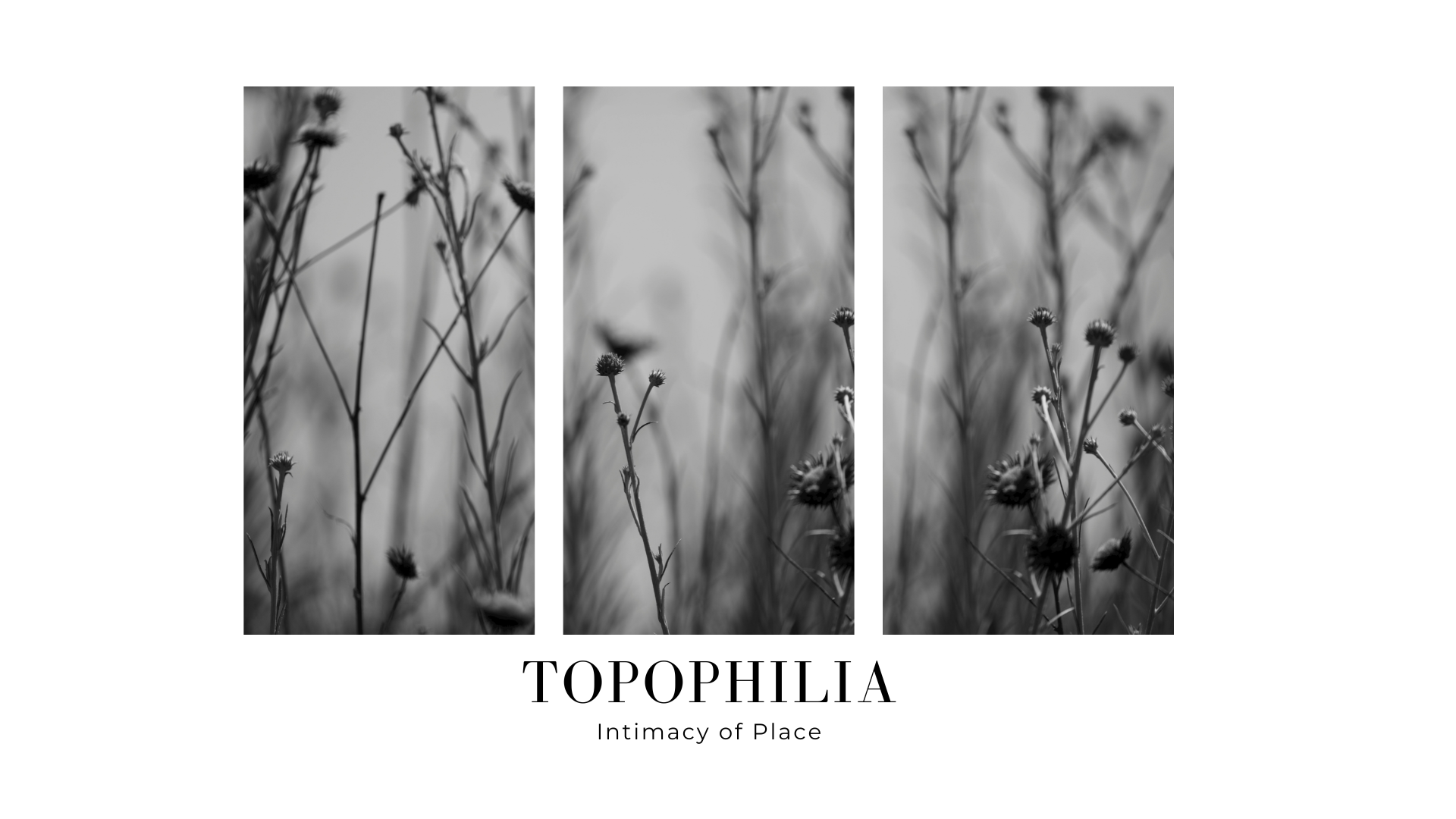
Topophilia: A Different Kind of Intimacy
Topophilia, noun
“Love of, or emotional connection to, a particular place or physical environment.” - Oxford English Dictionary
Topophilia is a term used to describe a deep connection developed between people and a place. Yi-Fu Tuan beautifully curated the language for topophilia in the late 1970s, while indigenous communities across the world have practiced and taught the craft and way of being that is topophilia since human connectivity came into being.
Some researchers study adjacent constructs such as people’s place identity, place attachment, and other words and phrases I have yet to uncover.
I like topophilia best, as I described in a recent graduate paper - “The Greek topos, meaning place or space, meets the Greek philia, denoting friendship or affection, to form a portmanteau intended to highlight the intimacy between humans and their supportive spaces.”
Because I love the nuance and breadth of Hebrew so much I have half a mind to make up my own version of topophilia with Hebrew terms - take rea’, a term for friend or companion, denoting the nourishment of friendship, the shepherding and influence that resides when intimacy grows and knits itself into our hearts, minds, and lives. Then take maon, a dwelling place, often sacred, such as the tabernacle, but also any refuge, protective, set apart. Reamaon - a place God crafts in our lives to hold us in all of life’s tensions and turmoils, joys and juxtapositions.
The places of our lives are more than background scenery. They are connected to and within us. While some places might roll by as green screens, barely noticed, others stick. Environments serve as settings and holders of stories in visual art, oral and written history, family albums, and the conversations of everyday life. What I found in a recent focus group I led for my coursework revealed another layer - The spaces humans engage with serve as intimate companions, birthing and bearing the emotions of a life, increasing our awareness through the senses, and bringing conscious recognition of our perceptions and values, so that we know who we are, who God is, what this life is all about, a little more, a little deeper.
Not all places are equal. Yet, some places in our lives are restorative. They bring us energy and renewal. They remind us there is more to be had than sorrow. They give us room to explore. They allow us to turn down the hyperawareness of our nervous system just enough that we can hash out our identity, our relationships, and the big things of life, like sense and meaning.
These places hold us, rather than expect from us. This is topophilia.
Sometimes these places are spots in our home, sometimes an extension of our selves, such as a friend or a grandparent; the green and blue spaces of nature are high in the running for “most likely to be topophilic.” But I have questions - what if the educational spaces and sacred spaces of our communities gave attention to this concept? What is in fact being destroyed within our young people because guns are shattering our schools? What damage is done when sacred spaces are challenged to find the co-habitation of both grace and accountability?
As an interpretative critical realist, I am leaning into studying topophilia because I love intimacy and I love people’s stories. I love the interweavings and connectivity of life and this big, beautiful world, and I also know the shadows hiding in both our spaces and our inner worlds. I want to make more space for both the beauty and the ashes, both the burnings and still be there for the finding, the sorting, and the hearing of restorations.
Topophilia is a unique slice of the pie of what intimacy is. It allows me to study intimacy closer, without getting lost in the weeds trying to explain to everyone that not all intimacy is sex and sometimes sex doesn’t even begin to touch the real wonders of intimacy. (Although, I am a fan of sex and I wonder if there is a research study just waiting to be written on the interaction between topophilia and good sex. Hmmm.)
Where have you found topophilia in your life? What spaces not only offer safety, but a companionship? These spaces help you discover and explore, establish who you are, and hold the disappointing and glorious fact of life that none of us know quite yet all of who we are or what it all means, and yet we can call this life our own.
There is an incredible amount of agency in topophilia. I believe it might be helpful when choices have been taken away from us. When poverty or imprisonment or bad relationships take from us, topophilia might have some insight for returning our self to us once again.
It is just like God to say, “Here is something weird and random and wildly complex and gentle and sweet and crafted just for you.” God is the Leslie Knope to our Ann Perkins-ness. For some reason, in some way, God calls us glorious land mermaids, and we find ourselves in these generally good and shitty lives of worry and wonder. And we are not left. We are not forsaken. We are companioned and held and we grow.
Topophilia, like so much discovered and yet to be uncovered, is a resource that makes life livable and thriving, rather than only surviving, possible.